
June 4, 2026
Managed Platform Adoption: The Exit Cost Nobody Calculates

Chintan Viradiya
Author

Shyam Kapdi
Contributor

Shailesh Davara
Reviewer
Most platform decisions are made on speed and features. The cost of getting out is rarely part of the conversation until it’s too late.
I have watched many platform decisions get made over the past fifteen years. The conversation almost always goes the same way. The team evaluates a managed service, some database, a messaging layer, a deployment platform, and the discussion focuses on two things: how fast can we get started, and does it do what we need today?
Nobody asks: what happens if we need to leave?
That question feels premature when you’re trying to ship. But I can tell you from watching dozens of companies go through forced migrations, because of pricing changes, acquisitions, feature gaps that never closed, that the cost of leaving a platform you didn’t build with exit in mind can be catastrophic. Not just expensive. Months of engineering time, data at risk, and in some cases, complete rewrites of systems that were supposed to be long-term foundations.
Exit cost is not an engineering concern. It is a business risk. Treat it like one.
1. How Vendor Lock-In Happens Without Anyone Choosing It
Nobody signs a contract that says “we are choosing to make this platform irreplaceable.” It happens gradually.
You adopt a managed service because it solves an immediate problem well. Your team builds on top of it. Features get added. Integrations multiply. And at some point, usually 18 to 24 months in, the platform is no longer just something you use. It is woven into how your product works. The data format is specific to that vendor. The APIs your engineers call every day don’t exist anywhere else. Your deployment process was designed around that platform’s model.
At that point, you are not a customer anymore. You are a captive.
The worst part is that no single decision created this situation. It was fifty small decisions, each of which made complete sense at the time. That is what makes platform lock-in so hard to prevent; it doesn’t feel like a mistake while it’s happening. (If you want a technical look at how we untangle these messes, read our breakdown on using GitOps and FluxCD to escape CI/CD vendor lock-in.
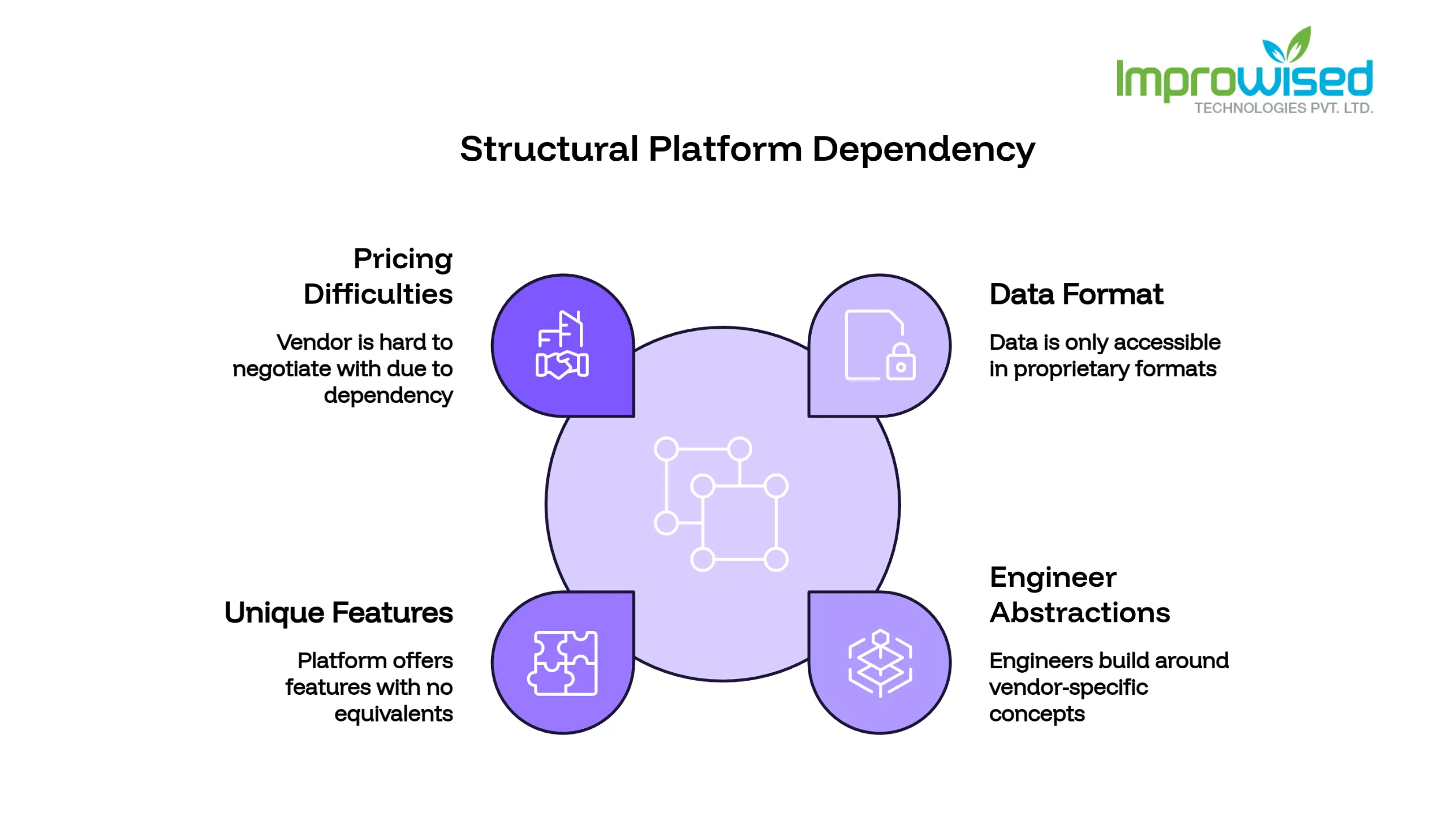
2. 4 Signs Your Platform Dependency Is Becoming Structural
There are signals that a managed service is moving from “useful tool” to “thing we cannot operate without.” Most companies see these signals and don’t act on them because acting would slow things down. Here is what to watch for:
-
Your data only lives in their format. If your data can only be exported in a proprietary format that requires their tooling to read, you are already partially locked in. Portability starts with the data.
-
Your engineers build around their abstractions, not yours. When your team’s internal code starts depending on vendor-specific concepts, their queue model, their event types, their identity constructs - you are building on someone else’s foundation. Moving later means rebuilding that foundation, not just switching a connection string.
-
You are using features that have no equivalent elsewhere. Every “advanced” feature you adopt from a managed platform is a link in a chain. This is not an argument against using good features. It is an argument for knowing which ones have no substitute, and what that means for your options.
-
Pricing conversations have become difficult. When a vendor is hard to negotiate with, that is usually because they know you can’t leave. If you feel like you have no alternatives, and the vendor seems to know it too, that feeling is worth taking seriously.
None of these signals means you should leave. They mean you should have an honest conversation about what leaving would actually cost in time, money, and engineering capacity.
3. Define Exit Criteria Before You Adopt Any Managed Service
The best time to think about leaving a platform is before you join it. This is not pessimism. It is the same logic behind any well-structured contract or business relationship.
“What would make us want to leave, and how would we do it?” This question should be asked before every significant platform adoption.
Here is what I ask before adopting any significant managed service:
-
What specific conditions would make us reconsider this platform? Price increase above a certain threshold? A competitor acquiring the company? A key feature being deprecated?
-
How would we get our data out, and how long would it take? Not the marketing answer. Ask your engineers to actually walk through what a migration would require. If nobody knows, that is its own answer.
-
What would we run instead? You do not need a migration plan on day one. But you should be able to name an alternative. If there is none, document that and make it a deliberate choice, not a blind spot.
-
What is the realistic cost to migrate in 18 months? Not exact. A rough number. If that number is larger than a year of platform spend, you are taking on significant risk.
These are not questions your head of engineering should answer alone. They are business questions. The answers affect your company’s future flexibility, and that conversation belongs at the leadership level. (If your team isn’t sure where your current dependencies lie, an external Infrastructure and Architecture Review can map your exit risks before they become critical.
4. Data Portability Is a Business Requirement, Not a Technical Checkbox
When vendors talk about data portability, they usually mean: you can export your data. That sounds like enough. It is often not.
Data portability, done properly, means you can export your data in a format that another system can actually use, within a time window that does not break your operations, without needing the original vendor’s tools to complete the process.
A company I worked with closely had 40 million records in a managed database platform. When they needed to migrate, the vendor was acquired, and the new pricing was not workable. They discovered that their export took 11 days to complete, required their vendor’s proprietary tooling to process, and produced a format that needed a full transformation pipeline before any other system could read it. They had three engineers working on that migration for four months.
That is not an extreme case. It is a common one.
Before you adopt a managed data service, your team should answer these questions concretely:
-
Can we export data incrementally, or only in full dumps?
-
How long does a full export take at the current data volume?
-
Does the export format require vendor tooling to process?
-
What transformation work would be needed to load this data into a different system?
If the answers are vague or your team has not tried it, schedule a drill. Export a real slice of data. Go through the process. Find out what you are actually working with before you need to know in an emergency.
5. What an Open-Core Architecture Looks Like in Real Production
“Build for portability” is advice that sounds obvious and is rarely followed because nobody has time for it when they’re building fast. But there is a practical version of this that does not require slowing down.
The principle is straightforward: put a thin abstraction layer between your product and the managed platform. Not a complex framework. Just enough so that the rest of your system talks to your abstraction, not directly to the vendor.
In practice, that means things like:
-
Your application code calls an internal messaging interface, and the managed queue sits behind it, not the other way around.
-
Your data access goes through a layer your team owns, so changing what sits underneath it is a contained problem, not a company-wide rewrite.
-
Configuration for vendor-specific behavior is centralized, not scattered across every service.
Companies that do this well are not necessarily building more slowly. They are making a different set of trade-offs: slightly more upfront work, in exchange for future flexibility that becomes worth a great deal when circumstances change.
I have seen companies with this approach complete migrations in three weeks that took other companies four months. Not because they were smarter. Because they had kept the option open. For example, when we built a Multi-Cloud Hosted Data Lake Platform, we used this exact open-core approach to ensure seamless integration across AWS, GCP, and Azure without getting locked into any single provider’s ecosystem.
Before Your Next Platform Decision, Do This First
I am not saying avoid managed platforms. They exist because they are genuinely useful. I use them. The companies I work with use them. They reduce operational load, accelerate development, and solve hard problems well.
What I am saying is this: the decision to adopt a managed platform should include a clear-eyed view of what it would cost to leave. That cost belongs in your evaluation alongside the setup time and the feature list every single time.
Before your next significant platform adoption, ask your team to spend two hours answering the exit questions in section three. Write down the answers. If the cost of leaving is acceptable, move forward with confidence. If it is not, either negotiate better terms, build your abstraction layer, or make a deliberate choice to accept the risk with your eyes open.
Platform risk is business risk. The exit conversation should happen before you enter, not after you realize you can’t leave. That is the whole argument. No diagrams required. Contact us today to evaluate your platform dependencies and build a cloud-native architecture that keeps your options open.
That is the whole argument. No diagrams required.
Frequently Asked Question
Get quick answers to common queries. Explore our FAQs for helpful insights and solutions.
Vendor lock-in rarely happens from a single bad contract; it happens gradually over 18 to 24 months. You adopt a managed service to solve an immediate problem, but over time, your data becomes tied to their proprietary format, your APIs rely exclusively on their ecosystem, and your deployment process molds to their specific model. You become captive through dozens of small, seemingly logical engineering decisions.
Four critical structural signals indicate heavy lock-in:
- Your data only lives in the vendor's proprietary format.
- Your engineers are building internal code around the vendor's specific abstractions (like their unique queue models) instead of your own.
- You are deeply relying on "advanced" features that have no equivalent competitor.
- The vendor becomes highly inflexible during pricing negotiations because they know you cannot easily migrate."
You must define your exit criteria before you adopt the managed service. Before signing, establish the specific triggers that would force a migration (like a price increase or a vendor acquisition), document exactly how you will extract your data, identify a realistic alternative platform, and calculate a rough estimate of what a migration would cost in engineering hours 18 months down the line.
True data portability means you can export your data incrementally (not just in massive full dumps), in a standard format that another system can immediately read, and without relying on the original vendor's proprietary tooling. If your export takes days to complete or requires a massive transformation pipeline before another database can read it, your data is not portable.
You prevent lock-in by building a thin abstraction layer between your product and the managed platform. Instead of your application code calling the vendor's database or messaging queue directly, have it call an internal interface that your team owns. If you need to swap the underlying managed service later, you only have to update that single abstraction layer rather than executing a company-wide rewrite.
Written by
Chintan Viradiya
Chintan Viradiya is a DevOps Engineer at Improwised Technologies. Passionate about Infrastructure as Code and CI/CD pipelines, he focuses on optimizing cloud deployments and enhancing the security and performance of modern applications. He plays a key role in ensuring high availability and driving DevOps best practices across projects





Optimize Your Cloud. Cut Costs. Accelerate Performance.
Struggling with slow deployments and rising cloud costs?
Our platform engineering solutions are built on open-source tools and use AI natively across the workflow.