
November 5, 2025
7 Signs Your Organization Needs Platform Engineering

Shyam Kapdi
Author

Priyank Dhami
Contributor

Shailesh Davara
Reviewer
Engineering speed isn’t optional anymore - it’s survival. Companies that release faster, with stability and control, lead their industries. The rest play catch-up. Yet most engineering teams are not limited by talent or creativity - they’re limited by tangled infrastructure, sluggish deployments, and tool sprawl.
That’s where Platform Engineering enters.
It’s not another DevOps trend. It’s a systematic shift - building a self-service Internal Developer Platform (IDP) that lets developers build, test, and ship without bottlenecks. It standardizes delivery and makes infrastructure predictable. The result? Developers focus on product innovation instead of provisioning servers.
But when exactly does an organization become ready for Platform Engineering? Let’s break it down - seven clear signals that it’s time to make the leap.
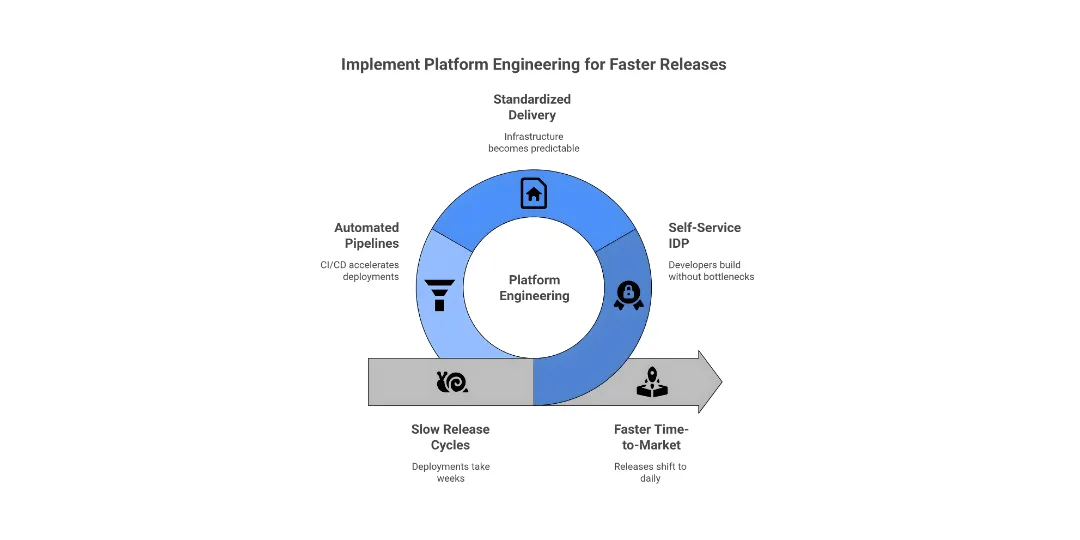
1. Developers Spend More Time Managing Infrastructure Than Writing Code
Developers should be writing code, not juggling Terraform scripts or debugging flaky CI pipelines. If half your team’s energy goes into managing Kubernetes clusters or configuring environments, something’s broken.
The Challenge
As companies scale, so does infrastructure complexity. Manual environment setups, configuration drift, and fragmented processes creep in. One small update in staging breaks production. Over time, developers burn out and release velocity drops.
How Platform Engineering Fixes It
By implementing a self-service internal platform, you eliminate dependency on manual processes. Developers get:
- On-demand environment provisioning through tools like Terraform, Crossplane, or Pulumi.
- Reusable templates for consistent infrastructure setups.
- Automated pipelines connected to version control.
With the adoption of the platform engineering services, teams get frictionless access to pre-approved resources, so coding, not firefighting, becomes the focus.
Also Read: How Internal Developer Platforms Reduce Deployment Times by 2-3x
2. Release Cycles Are Slowing Down
If deploying to production feels like a multi-day process full of approvals and manual QA, your delivery model isn’t keeping pace.
The Challenge
As products evolve, pipelines that once worked become brittle. Manual testing, inconsistent environments, and slow rollouts lead to stagnation.
How Platform Engineering Fixes It
A platform-centric model accelerates everything:
- Continuous Integration for every commit - running tests, scans, and builds automatically.
- Continuous Deployment with GitOps-driven rollouts using FluxCD or ArgoCD.
- Deployment visibility and rollback are baked into the workflow.
Improwised Technologies’ clients in SaaS and healthcare moved from 3-week release cycles to 3 days - maintaining compliance while scaling safely.
A stable CI/CD pipeline is no longer a luxury; it’s the backbone of velocity.
3. “It Works on My Machine” Keeps Coming Up
That phrase is every team’s silent scream. It signals one thing - environment drift.
The Challenge
Local, staging, and production rarely match perfectly. When configs or dependencies vary, releases fail. Debugging these inconsistencies wastes hours - sometimes days.
How Platform Engineering Fixes It
By enforcing parity and version control:
- Infrastructure as Code (IaC) ensures every environment is reproducible.
- GitOps pipelines keep the actual state synced with code.
- Prebuilt environment blueprints eliminate manual setup.
The outcome? One configuration to rule them all. What runs locally will run in production without any surprises or excuses.
4. Scaling Infrastructure Feels Manual and Reactive
If you’re scaling only after getting alerts or customer complaints, your infrastructure strategy is reactive and risky.
The Challenge
Manual scaling leads to either wasted cloud spend (from overprovisioning) or outages (from underprovisioning). Both cost money and reputation.
How Platform Engineering Fixes It
Modern platforms introduce predictive and automated scaling:
- Autoscaling policies for workloads and databases.
- Performance-based adjustments based on CPU, memory, or custom metrics.
- FinOps dashboards (Kubecost, Azure Cost Management) for cost visibility.
Our company integrates Kubernetes-based scaling mechanisms with financial insight, cutting costs by 30–50%. Infrastructure becomes elastic and not chaotic.
5. Security and Compliance Are Afterthoughts
If access control still happens via chat messages or secrets live in shared docs, you’re running on borrowed time.
The Challenge
Every service, container, and environment expands your attack surface. Manual credential management and delayed security reviews mean vulnerabilities often reach production.
How Platform Engineering Fixes It
Security becomes part of the delivery fabric:
- IAM and RBAC ensure least-privilege access.
- Secrets management is centralized with Vault or AWS Secrets Manager.
- Automated SAST, DAST, and IaC scans are built into CI/CD.
- Compliance as Code enforcing ISO 27001, SOC 2, and GDPR.
With Improwised Technologies’ frameworks, security shifts are left-embedded in development, not bolted on later.
6. Your DevOps Team Is Overwhelmed
DevOps should be building automation, not responding to a queue of tickets. Yet, in many organizations, DevOps becomes a bottleneck.
The Challenge
Without automation and self-service, developers rely on DevOps for every deployment, permission, or config tweak. That kills momentum and morale.
How Platform Engineering Fixes It
By empowering both sides:
- Developers self-serve environments, deploys, and rollbacks safely.
- Guardrails maintain governance without friction.
- Observability tools give teams transparency without manual status checks.
One of our clients saw a 60% drop in operational tickets post-IDP rollout. DevOps moved from reactive firefighting to proactive optimization.
Also Read: platform engineering vs DevOps: Which one is best for your company?
7. You’re Scaling Fast, but Your Tooling Isn’t
Growth exposes weaknesses. If your infrastructure feels cobbled together with overlapping dashboards, random scripts, and duplicated configs. Then, you’re past the point of manual fixes.
The Challenge
Scaling without standardized tooling results in:
- Environmental sprawl.
- Rising costs.
- Governance gaps.
- Difficult onboarding for new hires.
How Platform Engineering Fixes It
- Version-controlled architecture that grows modularly.
- Unified observability stack with Grafana, Loki, and OpenTelemetry.
- Automated policy enforcement for compliance and costs.
- Onboarding automation for new teams and services.
Improwised builds cloud-agnostic IDPs that evolve with your business - AWS, Azure, GCP, or hybrid. Predictable scaling, consistent delivery.
Platform Engineering Is a Mindset, Not a Toolset
Tools matter, but mindset drives transformation. Platform Engineering isn’t about adding another dashboard; rather, it’s about enabling independence, repeatability, and safety across teams. It turns delivery into a product discipline.
At Improwised Technologies, we say: “Stop building tools. Start building systems that make tools work together”.
The Business Case: Platform Engineering ROI
| Benefit | Business Outcome |
|---|---|
| Faster time-to-market | Releases shift from monthly to daily |
| Lower operational costs | Automation reduces waste and manual effort |
| Improved developer productivity | Developers focus 80%+ on code, not ops |
| Enhanced reliability | Fewer incidents, faster recovery |
| Continuous compliance | Policies enforced automatically |
| Predictable scalability | Growth without chaos |
Case Study - From 3 Weeks to 3 Days
A healthcare company came to Improwised Technologies with long deployment cycles and unstable infrastructure. Their release cycle took three weeks. After implementing a custom IDP with GitLab CI, FluxCD, and Kubernetes:
- Releases dropped to 3 days.
- Over 7,000 releases per year.
- 50% reduction in cloud spend.
- Improved visibility and compliance.
That shift changed not just delivery speed - but the way teams thought about deployment ownership.
Ready for Platform Engineering?
If three or more of these signs sound familiar, your organization is ready. Improwised Technologies platform engineering consultants design, implement, and scale IDPs that combine automation, observability, and compliance. Our frameworks are modular, cloud-agnostic, and cost-optimized, and they are hence perfect for scaling enterprises and fast-moving startups alike.
Frequently Asked Question
Get quick answers to common queries. Explore our FAQs for helpful insights and solutions.
Platform Engineering is the discipline of designing and maintaining internal developer platforms (IDPs) that enable teams to build, test, and deploy software efficiently. It introduces automation, consistency, and scalability into development workflows. Its importance lies in how it bridges the gap between development and operations - reducing manual work, improving reliability, and empowering developers with self-service access to infrastructure. For modern businesses, it’s the backbone of agility and secure delivery.
Your organization needs Platform Engineering when developers spend more time fixing pipelines than coding, release cycles slow down, or scaling becomes reactive. Frequent production issues, duplicated tooling, and dependency on manual approvals are strong indicators, too. If you’re struggling to maintain velocity, it’s time to invest in a standardized internal platform.
Key challenges include fragmented DevOps processes, environment drift, inconsistent security policies, and bottlenecks in release management. Manual infrastructure provisioning, repetitive operational requests, and rising cloud costs also signal the need for Platform Engineering. These pain points reveal that your team needs automation, governance, and self-service tooling.
Absolutely. Startups benefit massively from adopting Platform Engineering early. With smaller teams, resource constraints, and a need to scale fast, startups can’t afford inefficiency. By partnering with Platform Engineering service providers like Improwised Technologies, startups can build lightweight, modular IDPs - aligning scalability and cost optimization from the start. It’s not about size; it’s about readiness to automate.
The initiative is typically led by the CTO or Head of Engineering. However, success depends on collaboration among DevOps engineers, infrastructure architects, and senior developers. The best leaders are those who understand both technology and culture - they treat the platform as a product, not just a toolset.
Platform Engineering transforms DevOps from gatekeepers to enablers. Developers get autonomy through self-service environments and automated pipelines. DevOps focuses on optimization instead of manual provisioning. The result: faster releases, better collaboration, reduced burnout, and consistent compliance across all environments.
Assess readiness - Identify pain points in infrastructure and delivery. Define goals - Align platform objectives with business needs. Design architecture - Use Infrastructure as Code and GitOps principles. Start small - Build a minimum viable platform before scaling. Automate CI/CD and observability - Embed monitoring and security early. Train teams - Promote a self-service and ownership culture. Improwised Technologies assists teams at each stage - from discovery to full-scale implementation.
DevOps focuses on collaboration between developers and operations. Platform Engineering builds the tools and automation that make that collaboration seamless. DevOps defines how teams work; Platform Engineering defines where and with what they work. It’s the foundation on which DevOps runs efficiently.
If your releases are delayed, infrastructure scaling is manual, and developers are bogged down by operations - the time is now. The earlier you standardize your delivery pipelines and infrastructure, the smoother your scaling will be. Waiting too long only compounds inefficiency and risk.







Optimize Your Cloud. Cut Costs. Accelerate Performance.
Struggling with slow deployments and rising cloud costs?
Our platform engineering solutions are built on open-source tools and use AI natively across the workflow.